
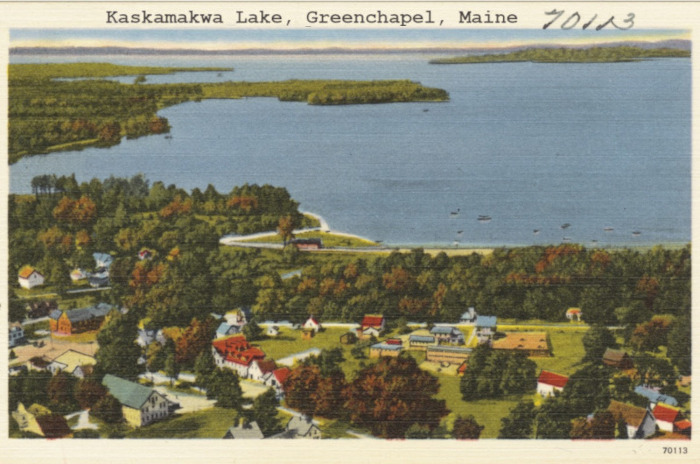
Twenty years ago I found myself teaching high school English in a rural, Maine town. I hadn’t planned to and I didn’t do it long (just six years), but it was a fertile place and time for story ideas. It was while I was teaching that I created the town of Greenchapel, Maine, a strange place, probably cursed, situated on State Route 24a not far from the New Hampshire border. I would return there from time to time to check in with the locals and see what new stories had emerged from the Mikanasek Forest or dragged themselves from Kaskamakwa Lake. A few months ago Greenchapel loomed up in my mind, reminding me that it wasn’t done with me quite yet. I have been working now and then on a collection of short stories set in Greenchapel. ‘Hypothesis’ is one of them. Tell me what you think in the comments and, as always, thanks for taking the time. — Rob
Hypothesis by Rob Wheeler
“Did you see they’re messing with dark matter again?”
Mary turned a page in her magazine and answered in the negative without looking up.
“Something called the ‘Hubble Tension’ makes them think they have it all wrong. Again. You’d think they’d just start over by now. Einstein makes some predictions like a hundred years ago, but the numbers don’t add up, so the others add some stuff—made up stuff—so that they can smuggle in some more numbers to make the first ones work. Then when the stuff they smuggle in turns out to not be right, they change it and change it and now they’re changing it again. Scientists will do anything not to throw a bad theory in the trash.”
“Just like you and those jeans.”
Roger snorted. “I like those jeans. They’re perfectly good jeans.”
“Yes dear,” said Mary as she entered the final third of the April issue of ‘Stitches: the Monthly Digest of the New England Sewing Circle.’ “They’re on the end of the ironing board.”
“Thanks for patching them up. Again.”
“Uh huh. They’re more patches than pants at this point.”
“Just like gravity,” he said, provoking a raised brow from the woman that kept him patched up and going in every possible way.
Roger folded the Kaskamakwa Gazette, nodded toward the glossy magazine his wife of thirty-two years was reading and asked, “Anything good in there?”
“Oh, sure. Here’s a thing about upcycling buttons and another one about making custom buttons out of resin.”
“Is that the button issue?”
“It might be,” she smiled. The light from the kitchen window made the line of her cheek glow golden. “But don’t tell Harriet Okembo—she wants me to ‘Transform my cuffs and collars with this one neat trick.’”
“Poor Harriet didn’t get the memo.”
“I guess not.”
Roger polished off the last of his second cup of coffee, exchanged glances with Snoopy who, according to the slogan painted on the milk glass mug, ‘Was not worth anything before his coffee break,’ and considered making a fresh pot when Mary read his mind.
“I’ll put some on. It will be ready when you come back in. Don’t forget the eggs.”
“Thanks, Toots,” he said, pushing himself up from the chair and leaning in for a kiss on her cheek that made her smile. “Where would I be without you?”
“The same place as those pants—the trash,” she said, still smiling.
* * *
A log truck chugged by a half-mile away, down on 24a. He could just make it out, appearing and reappearing through gaps in the greenery that was coming alive all over the valley. It’s rumbling air break sounded, rolling up the hills, faint, but loud enough to sound like thunder in the quiet morning. He lost it as it rounded the foot of Penibagos Peak, his view from the porch of the two-hundred-year-old cape good but not that good.
It was warm already at not-quite-six-thirty and would only get warmer. Mist hung over the field, clinging to the row of crooked apple trees. They were bent like old women stuck in yoga poses, their branch-hands lost in last-year’s tall grass. They needed cutting back, a thing he would have gotten to last fall if it hadn’t been for Amy. Thought of his daughter taken way too young by cancer darkened his mood, but he kicked himself in the butt same as she would have done and shook off the blues as he walked across the gravel yard to where the chickens were waiting to be let loose on the world. Five black shapes trundled into view as he rounded the old maple-shack turned coop. The turkeys were wild but sometimes had to be reminded of the fact. They circled him warily, waiting for the inevitable spilled scratch grain that kept them coming back. A big Tom was in full strut, his tail feathers fanned out. He sidled like a Macy’s float around the hens who could not care less about the display.
“Be patient, Phyllis,” Roger said as he retrieved a hanging pail and opened the grain bin. “You too, Margaret. You know you’ll get some.”
The one that was probably Phyllis cooed appreciatively. One turkey looked pretty much like another, ugly-cute in the way of lots of animal and plenty of people.
He filled a pail, scanning the grains for mice who sometimes made there way in and couldn’t get back out of the deep bin. Finding no interlopers, he scattered a pail-full across the lawn, making the turkeys shy and dance. They came down for breakfast every morning from the row of white pines that bordered the edge of their two-acre field, not quite domesticated but heading steadily in that direction. He and Mary liked to watch them fly up to the high branches as the sun went down. Some people thought that turkeys couldn’t fly, but then some people thought the universe was expanding. He shook is head at the idea, muttered, “Scientists…” beneath his breath, and closed the grain bin, second pail of scratch in hand.
He had just rounded the rear of the shed where the pop-hole door through which the busy hens would come tumbling as soon as he lifted it was when he stopped dead in his tracks. The field was in full view form that vantage, blocked only by the wire mesh of the fenced chicken run, and something was in it.
He shot a glance over his shoulder to make sure Mary hadn’t followed him outside as she sometimes did. The porch was empty. Mary was safe inside. That worry put away, he set the still-full pail on the ground and tried to make sense of what he saw.
It was a boulder, huge and dark and warm, judging by the steam that billowed off of it. It had the look of the glacial erratics that one came across hiking or hunting in the woods of western Maine, but unlike those it was lichen-free and smooth and it had no business being in his field. It hadn’t been there yesterday and unless it had been pushed up out of the ground by the winter freeze like the yearly harvest of rocks for which Maine farms were famous it had nowhere from which to have come. Their little patch of land was on top of one of the dozen hills that rimmed the Kaskamakwa Valley—there was no place for a boulder to have got loose and rolled from, unless they had learned to roll up hill. The turkeys at his back seemed untroubled by it; they were pecking busily at their breakfast, eyes as black as the stone keeping track of his movements. The noise of the chickens still inside the coop reminded him of his original chore. Still watching the stone as though it might move, Roger unlatched the door to the run, stepped inside, and lifted the pop-hole’s hatch. Six plump hens and a strutting rooster came toddling out, eager to get at the grains he had forgotten to scatter.
Task half-completed, Roger closed the run distractedly, eyes still on the thing in the field. He took a few steps toward it and stopped, wondering if he should go get Mary. Deciding against it, he started walking toward where it sat, steaming. Could it be a meteorite? He surveyed the unburned grass around it and dismissed the idea. There was no sign of any impact and if something that size had come from outer space there probably wouldn’t have been a Maine left to stand in. It seemed too smooth to be natural, but that might have been the distance; he was still over a hundred yards away, the thing being in the approximate middle of the field. The sound of a car made him turn toward the road, but it was only Garth Keeler’s bi-colored F-150. His nearest neighbor, Garth drove into town near-every morning about the same time to sample the wares at Uncle Andy’s Bakery over on the lake. He must not have noticed anything, for the sound of the noisy truck soon faded, leaving Roger alone with the stone again.
Without really seeing it, his eyes fell upon a rake leaning against a post by the patch of roses he had been trying to tame yesterday. With an outstretched arm, eyes still locked on the impossible boulder, he retrieved it, holding it like a spear across his chest, just in case he needed to rake the boulder to death or something. Stupid as it was, he felt better armed and it was with steadier steps that he finally entered the field.
And stopped.
Thirty years ago, when he was in college, he had worked painting the chain-link fences around electrical substations all over the county. Despite being around them five days a week for seven months straight he had never gotten comfortable with the visceral hum of those contraptions. It got into your blood, made your organs tingle, and reminded you that even a strong, young buck of twenty-one-years was a goner should he so much as brush up against one of those thrumming pylons. The stone was giving off the same sort of hum, insistent and low, a vibration just below the range of human hearing and all the more alarming because of it.
A sudden scuffle from the direction of the chickens grabbed his attention. Margaret had resumed her favorite perch atop the run’s tall fence, coming to rest unsteadily with a mad flap of her wide wings. The chickens milled about below her, looking up as though praying to their avian god.
Turning back to the stone, Roger’s heart froze—it was closer. At first he thought it must have moved, but then he looked down at his feet and realized he had walked ten or more steps toward it while distracted by the birds. He gripped the rake more tightly, turning his knuckles white, eyes fixed to the humming boulder.
He noticed the next steps he took. It was like he was hypnotized or watching someone else. He knew those feet belonged to him, but it was like someone was remote-controlling his nervous system, making him walk implacably toward the center of the field, toward the stone. One step followed another, his feet moving no matter how much he tried to make them stop. The hum had gotten into the rake now. He could feel it traveling through the fiberglass handle, hear the drop-forged metal tines buzzing, and yet still he walked on. Another twenty steps and he’d be there. He could see the whole of the stone now and wasn’t surprised in the least to see that it wasn’t resting on the ground at all but rather hovering maybe a foot above it. The grass beneath was crushed down as if by some great weight, making a sort of bowl. He was brought to mind of crop circles and found himself uttering a silent apology to all those men and women he had dismissed as pranksters and loons. He walked and the stone thrummed. The vibration was deep in his chest now; he could feel it altering the rhythm of his heart. It would explode, he decided, before he even touched the sinister intruder, and even the knowledge of his own impending death was not enough to make his feet obey.
“Roger!” shouted Mary at his back. She was in the driveway, a yard away from the edge of the field, and her face was ashen. He knew she couldn’t hear the hum from there or else should would have been walking along behind him, a couple of helpless planets locked into the same, invisible orbit.
The sound of her voice jarred him and he thought it must have jarred the stone too. Something changed, its electrical will weakening just enough for him to force himself, stumbling, out of the field to his waiting wife. He collapsed into her arms, the rake whistling through the air behind him like a thrown spear as he let loose of it to take hold of her. It clanged against the stone and was destroyed, shivered into a million pieces.
They both took a few steps back, putting more distance between themselves and the field.
“What is that thing, Roger?” Mary asked, eyes wide.
“Dark matter,” was all he could manage as he slipped into an exhausted faint.
 Rob Wheeler Writes
Leave a comment