
Well, I’ve gone and done it again, put another novel into the world.
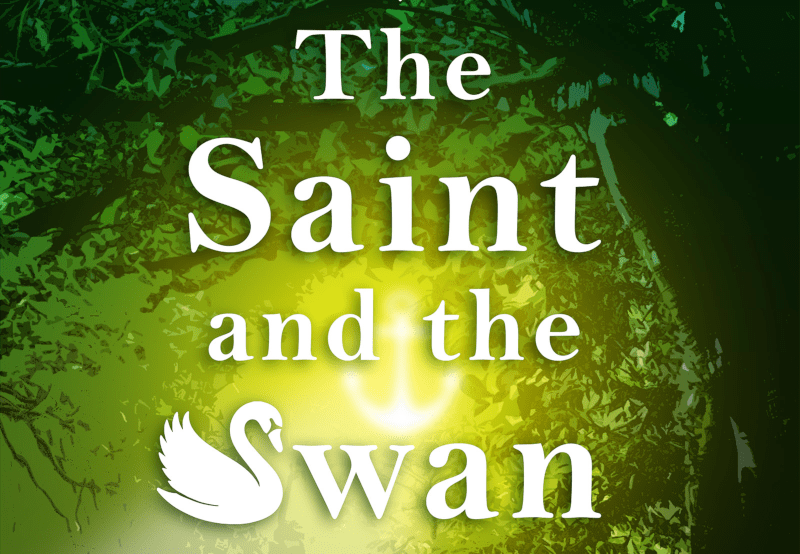
In the “Saint and the Swan,” second book of the Opal Throne Quartet, I was interested in a question that I seldom see explored in fantasy literature. That is, what is the role of faith in a world were monsters, magic, and the supernatural are objectively real? While developing Dorane I was struck with the idea that if there was a ‘One True God’ in even a single world it would necessarily follow that the same God would have to exist in one form or another in all possible worlds, even fictional ones. How would that singular yet infinitely varied God reveal Himself in a traditional fantasy world? Even in books set in times and places based on medieval Europe, as is the case with my own, the presence of faith is rarely felt except as a sort of constant, soft murmur, a whisper in the background that never quite rises to a level at which it can be plainly heard. Religion is often present in such settings, but almost universally as a villain, a power put to no other purpose but abuse. As a writer in a post-modern world I understand the temptation to frame all institutions as corrupt, but writing a monotheistic church as necessarily evil seems to me very tired, over done, and, frankly, boring. If I wanted to present a setting that was both familiar and fresh, one that challenged me and I hope will challenge my readers, I knew I had to take a different approach. Thus the Theorusian Church was born, a close cognate to the Christian one but with obvious differences that, I hope, emerge as he story unfolds.
Faith and religion (its most obvious manifestation) played an important role in “Beyond Saint Arden’s Wood,” but I knew its voice was still too soft. Having (predictably) explored magic in the first book, I knew I had to be brave and tackle faith in the book that followed. This established a pattern that appealed to me as a lifelong player (and mostly DM) of Dungeons & Dragons and other games, one that ended up leading to book three, “The Cat of Rukstad.” I introduced a wizard in book one, a cleric in book two… it seemed inevitable that book three would feature a thief.
But I am getting ahead of myself—back to “The Saint and the Swan.’
Needing one cleric I of course created several, the most central of which is the protagonist, Alvin, a young postulant on the verge of taking his monastic vows. In Dorane, all postulants must undertake a pilgrimage before committing fully to monastic life. While most travel to famous places, the destination chosen by Alvin comes to him in his dreams or, more accurately, his nightmares. Joined by his mentor, Brother Florent, the colorful Friar Bartolio, and a cadre of other travelers met upon the way, Alvin follows his visions and his guilt deep into Gynt, the Coastal Kingdom of least renown. The story that developed features a theme that has followed me my whole life. It seems to me that an error in our modern thinking is that multiple things cannot simultaneously be true. We declare that a thing cannot be that because it is this. It is a sort of intellectual blindness as well as a symptom of underdeveloped imagination, I think, to decide that one truth precludes another. It is my belief that many things (maybe all things) are both mythology and hard fact at the same time, that the moon is both an orbiting rock and the place where a rabbit roams. Because I am allergic to fundamentalism– religious, scientific, or otherwise– I am a natural agnostic, but instead of manifesting as a sort of bloated skepticism, it fosters in me an urge to see wonder wherever I look. In this second book I explore the idea that all truths are mythological and all myths are true and that even while we flawed Children of the Garden never seem to get the story exactly right, we do a much better job than we give ourselves credit. The trick Alvin needs to learn (and don’t we all) is being wise enough to see the whole tree, heartwood, roots and all, instead of just the leaves. And that brings me back to faith. Something that I hope that Alvin and the reader both discover during his perilous, wonderful journey is that the unarguable existence of monsters and magic makes faith more necessary than ever, for on a storm-tossed sea having an anchor is not optional.
If any of that sounds interesting to you, give “The Saint and the Swan” a try. It is available now in e-book and paperback. I have faith that you’ll find something in it to like.
 Rob Wheeler Writes
Leave a comment